Futsal vs indoor football: the complete guide to the differences
Same idea, two very different games: futsal follows strict FIFA rules with a low-bounce ball, indoor football adapts to every hall. Rules, court, kit and competitions compared.
In this article · 11 chapters
- Definitions and origins of the indoor games
- Tactical and technical differences between futsal and indoor football
- Competitions and official structure
- Indoor football: organised locally
- Who each game is for, and its benefits
- A practical guide to getting started
- 🎯 Futsal vs indoor football compared
- Performance analysis and evaluation
- Economic impact and development
- FAQ
- Conclusion: making the right choice for your goals
Speed, precision and intensity: that is what futsal embodies so brilliantly. The sport is often confused with indoor football, yet it has a unique identity that sets it clearly apart. So what really distinguishes the two? Every pass, every shot, every movement tells a story of agility and strategy in which every second counts!
The differences between futsal and indoor football are many and touch every aspect of the game: from the official rules to the equipment, the size of the court and the very philosophy of each sport. Understanding them will help you choose the one that best matches your expectations and goals.
Definitions and origins of the indoor games
Futsal: a codified sport recognised worldwide
Futsal takes its name from the Spanish “fútbol sala”, literally “indoor football”. It was created in 1930 in Uruguay by Juan Carlos Ceriani, a visionary physical education teacher who wanted to adapt football to small spaces while keeping the technical essence of the game. Read the full history of futsal.
FIFA officially recognised futsal in 1989, establishing universal rules and organising the first international competitions. Today more than 200 countries play the sport to FIFA standards.
Indoor football: a freer approach
Indoor football, on the other hand, refers more generally to playing football in covered spaces. Unlike futsal, there is no single international body governing it. The rules can vary from country to country, region to region, or even between sports centres.
This flexibility makes indoor football an ideal recreational option.
A detailed look at the differences between futsal and indoor football
Court dimensions and features
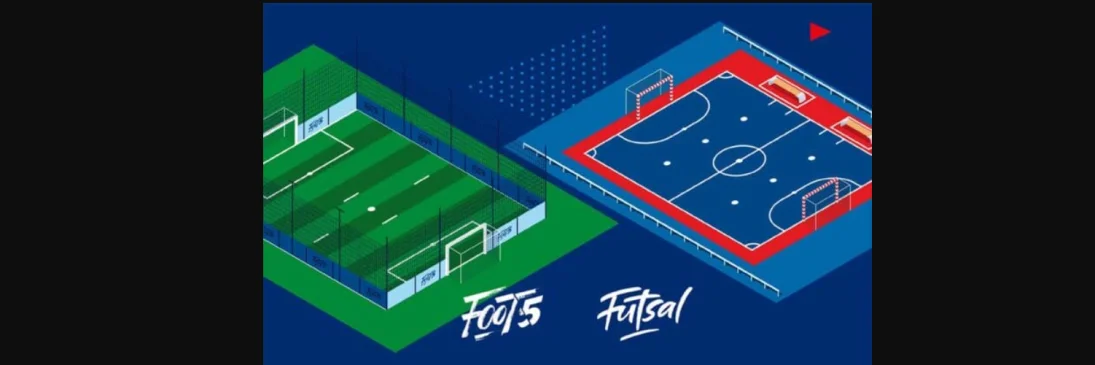
Futsal court (FIFA standards):
- Length: 25 to 42 metres (ideally 40 m)
- Width: 16 to 25 metres (ideally 20 m)
- Surface: must be smooth (wooden floor, synthetic)
- Goals: 3 m × 2 m
- Markings: lines no more than 8 cm wide
Indoor football pitch:
- Variable dimensions depending on the facility
- Surface: varies (synthetic, concrete, wooden floor)
- Goals: sizes vary with the space
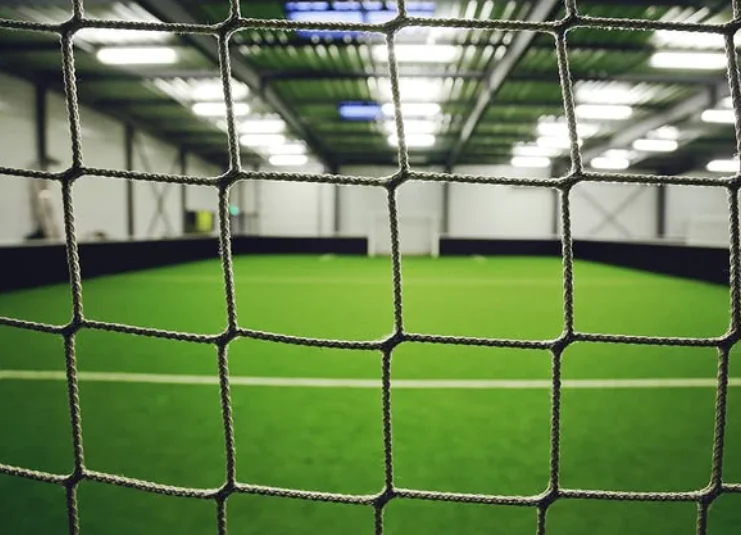
- Boards or walls: often present to keep the ball in play
- Markings: flexible, according to local rules
Equipment: crucial differences
| Item | Futsal | Indoor football |
|---|---|---|
| Ball | Size 4, low bounce (50–65 cm) | Variable size, a regular ball is possible |
| Shoes | Flat soles compulsory | Indoor shoes recommended |
| Kit | Shirt, shorts, socks, shin guards | Depends on the rules |
| Goalkeeper | Different shirt compulsory | Visual distinction recommended |
The futsal ball is one of the main differences. Its bounce is limited to 50–65 cm (compared with 125–155 cm for a regular ball), which encourages a more technical, precise game on the floor. See our guide to the futsal ball.
Rules of play: precision vs flexibility
Futsal rules:
- Duration: 2 × 20 minutes (effective time)
- Players: 5 v 5 (goalkeeper included)
- Substitutions: unlimited, rolling
- Accumulated fouls: the 5-foul system per team
- Kick-ins: with the feet only
- 4-second rule: for restarts, goal clearances and so on
In futsal, the 4-second rule puts a time limit on every restart, which keeps the tempo high and intense.
Indoor football rules:
Walls: sometimes allowed to keep play going
Duration: variable (often 2 × 15 or 20 minutes)
Players: usually 5 v 5 (adaptable)
Substitutions: by local agreement
Fouls: simplified system
Throw-ins / kick-ins: by hand or foot, depending on the rules
DOWNLOAD OUR RULES GUIDE
“Futsal rules: the essentials” (free PDF, in French)
Tactical and technical differences between futsal and indoor football
Formations and strategies in futsal
Futsal has developed specific tactical formations suited to the small number of players:
Classic formations:
- 1-2-1 (diamond): a balanced formation, ideal for beginners
- 1-1-2: favours attack, with two pivots
- 3-1: a compact block with one pivot as the attacking reference
- Square or 2-2: two lines of two to circulate the ball
Rolling substitutions allow fine tactical management of effort. A coach can make strategic changes to adapt the team to the different phases of play.
Techniques specific to futsal
Futsal develops particular technical skills:
- Directional first touch: essential with a low-bounce ball
- Accurate short passing: encouraged by the small space
- Tight dribbling: needed against constant pressing
- Finesse finishing: suited to tight angles
- Pivot play: using the player with their back to goal
Indoor football: adaptability and creativity
Indoor football allows more freedom in tactical interpretation. The flexible rules allow:
- Using the walls (in some variants)
- Adaptations to the participants’ level
- Simplified rules to put fun first
- Variable formats (3 v 3, 4 v 4, 6 v 6)
Competitions and official structure
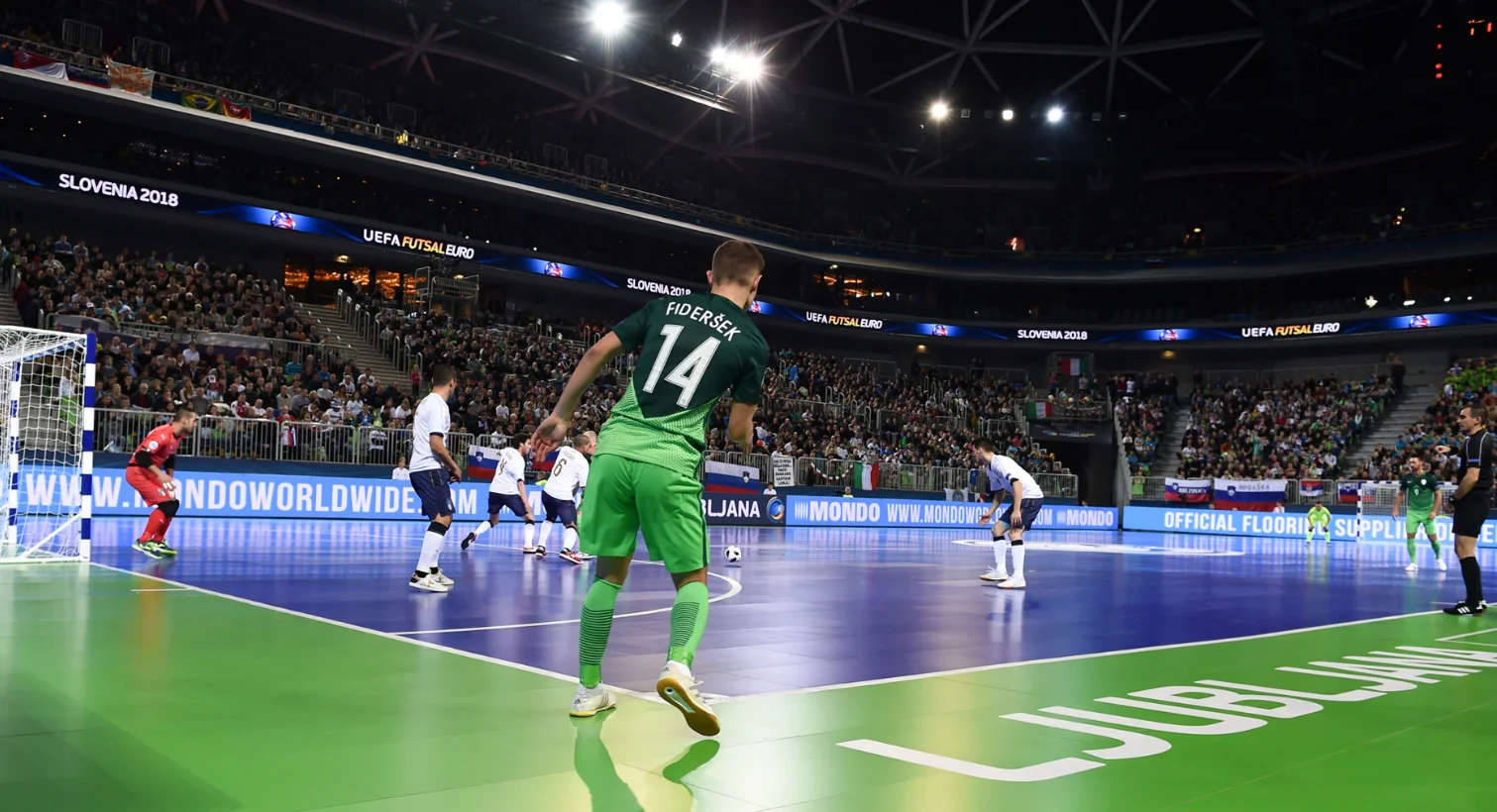
International futsal competitions
Futsal has a complete competitive structure:
FIFA competitions:
- FIFA Futsal World Cup (every 4 years)
- FIFA Futsal Women’s World Cup
- U-20 World Championship
The next 2028 FIFA Futsal World Cup (FR) promises to be a major event, with new candidate countries. Follow the European qualifiers.
Continental competitions:
- UEFA Futsal Euro (Europe)
- Copa América de Futsal (South America)
- AFC Futsal Asian Cup (Asia)
- Futsal Africa Cup of Nations (Africa)
How futsal is organised in France
National championships:
- D1 Futsal: men’s elite
- D2 Futsal: second division
- Women’s futsal championship
- Youth championships (U13 to U19)
French clubs are progressing fast. Analyses such as those of Meta Catania, Italian champions (FR), or Benfica, Portuguese champions (FR), show how tactics are evolving in Europe.
Indoor football: organised locally
Indoor football is mainly organised at local level:
- Municipal and county leagues
- Company and community tournaments
- Student competitions
- Private and corporate events
This decentralised structure makes it very accessible but limits the prospects at the top level.
Who each game is for, and its benefits
Who plays futsal?
Young players in development (8–18):
- Faster technical development
- Learning to make quick decisions
- In-depth tactical education
- Preparation for 11-a-side football
Competitive adults (18–35):
- Seeking performance and progress
- Playing in official championships
- Building team spirit
- Keeping a high fitness level
Passionate over-35s:
- Staying active
- Enjoying technical play
- Club camaraderie
- Coaching young players
The specific advantages of indoor football
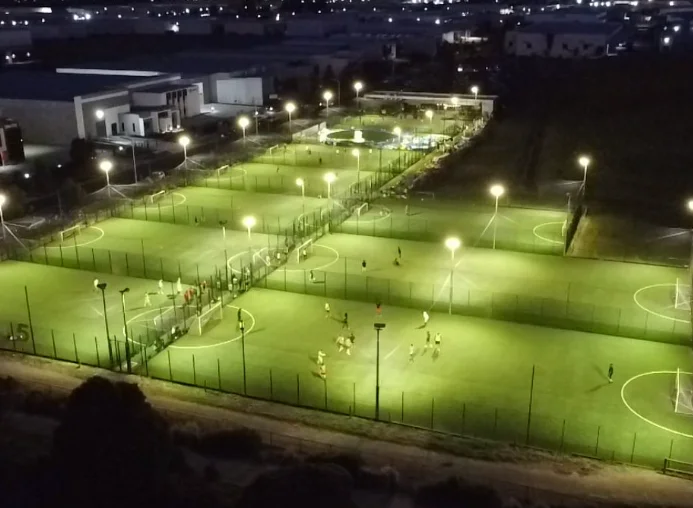
Accessibility:
- Simplified rules for all levels
- Less demanding facilities
- Lower organisation costs
- Great flexibility over times
Social aspects:
- Mixed play made easy (men and women, all ages)
- Beginners fit in quickly
- A relaxed, friendly atmosphere
- Corporate and family events
A practical guide to getting started
Choosing according to your goals
Choose futsal if:
- You are aiming for official competition
- You want to improve technically
- You like strict rules
- You are looking for a structured setting
- You want to join recognised championships
Choose indoor football if:
- Your priority is fun and relaxation
- You are new to indoor football
- You want flexible rules
- You are organising private events
- You value sociability
Starter kit
Complete futsal kit:
- Futsal shoes: flat, non-marking soles (€60–120). See how to choose them.
- Official ball: size 4, low bounce (€25–45)
- Kit: shirt, shorts, socks (€40–80)
- Shin guards: compulsory in competition (€15–30)
Basic indoor football kit:
- Indoor shoes: multi-sport shoes accepted (€30–70)
- Standard ball: size 4 or 5 depending on the rules (€15–25)
- Sportswear: comfortable and breathable (€25–50)
Finding a club or a court
Finding a futsal club:
- Check your national federation’s website (in France, the FFF futsal section)
- Contact your local or county football association
- Visit municipal sports halls
- Join specialist social media groups
Booking indoor football:
- Private sports complexes
- Municipal sports halls (free slots)
- Online booking platforms
- Leisure centres
🎯 Futsal vs indoor football compared
| ⚽ Futsal | 🏟️ Indoor football | |
|---|---|---|
| Duration | 2 × 20 min, effective time | Variable |
| Players | 5 v 5 (goalkeeper included) | Usually 5 v 5 |
| Kick-ins | Feet only | Hand or foot, depending on the rules |
| Fouls | 5 accumulated-foul system | Simplified system |
| Substitutions | Unlimited, rolling | By local agreement |
| Court | 25–42 m × 16–25 m, FIFA standard | Variable dimensions |
| Surface | Smooth, compulsory | Depends on the facility |
| Goals | 3 m × 2 m, fixed | Variable sizes |
| Boards / walls | Not allowed | Often allowed |
| Ball | Size 4, low bounce | Standard ball acceptable |
| Shoes | Flat soles compulsory | Multi-sport shoes accepted |
| Kit budget | €140–275 | €70–145 |
| Organisation | Official, FIFA-recognised | Local / regional |
| Competitions | World Cup, Euro, national leagues | Local leagues, tournaments |
| Level | Amateur to professional | Mainly recreational |
| Refereeing | Certified officials | Often self-refereed |
Performance analysis and evaluation
Evaluation methods in futsal
Modern futsal uses advanced analysis methods to evaluate performance. A post-match review (FR) lets coaches measure individual and team progress.
Key performance indicators (KPIs):
- Pass completion rate (target: over 85%)
- Duels won in defence and attack
- Ball recoveries by zone
- Attacking efficiency (shots on target / goals)
- Pressing intensity and high recoveries
Advanced tactical systems
Pressing while outnumbered is a tactical speciality of futsal. Our analysis of pressing while outnumbered (FR) shows how strategically complex the sport is.
Recent tactical developments:
- Using the goalkeeper as an outfield player in attack (see the power play)
- Constant rotations of the outfield players
- Ultra-high pressing as soon as the ball is lost
- Triangle play to create overloads (see passing triangles and diamonds)
Economic impact and development
The futsal market in France
French futsal is growing remarkably:
2024 figures:
- +15% registered players compared with 2023
- 450 clubs affiliated to the FFF
- Average D1 budget: €150,000 to €400,000
- TV audiences up 25%
Investment in facilities:
- New specialist futsal complexes
- Sports halls renovated to FIFA standards
- Public-private partnerships for development
- Training of referees and coaches
Outlook
Futsal is gradually establishing itself as the reference discipline for developing young footballers. The differences between futsal and indoor football are growing as the former becomes increasingly professional.
Trends for 2024–2028:
- Stronger presence in schools
- Faster growth of the women’s game
- Partnerships between professional football and futsal clubs
- Analysis technologies becoming widely available
FAQ
Can you easily switch from indoor football to futsal?
Yes, but it takes some adapting. Moving from indoor football to futsal requires specific learning. The main challenges are the low-bounce ball, the 4-second rule and the accumulated-foul system. Allow 2–3 months to master the basics of futsal.
Does futsal really improve performance in 11-a-side football?
Absolutely. Studies indicate that futsal develops individual technique up to 40% faster. Players who come through futsal show better vision, more precise control and quicker decision-making. Many professionals, such as Messi, Ronaldinho and Neymar, played futsal when they were young. Read more on how futsal shapes football talent.
At what age can you start futsal?
From 6–7 years old for a fun introduction. Structured learning can start around 8–9, with adapted rules. Futsal suits children perfectly because it gives them lots of touches of the ball and builds technical confidence in a safe space. See our guide to futsal for children.
Are injuries more common in futsal?
No, statistically fewer. Futsal is reported to have around 30% fewer injuries than 11-a-side football. The absence of violent contact, smooth surfaces and suitable shoes reduce the risks. The most common injuries are ankle sprains (prevented by warming up and strengthening). See our guide to preventing futsal injuries.
How much does a season of futsal cost?
Average annual budget in France:
- Club licence and membership: €120–250
- Initial kit: €140–275
- Extra costs (travel, tournaments): €80–150
- Total first year: €340–675
- Following years: €200–400 (partial kit renewal)
Conclusion: making the right choice for your goals
The differences between futsal and indoor football are profound and directly shape your experience. Futsal is the choice for those looking for technical excellence, structured competition and skills that carry over to football. FIFA recognition and official competitions offer clear pathways.
Indoor football remains ideal for recreation, a first taste and sociability. Its flexibility lets you adapt the game to any context and level, encouraging inclusion and the simple joy of playing.
Your choice will depend on your priorities:
- Performance and competition → futsal
- Fun and flexibility → indoor football
- Technical development → futsal
- Maximum accessibility → indoor football
Whatever you decide, both indoor games offer rewarding experiences. Explore MEDIA FUTSAL to deepen your knowledge of this exciting sport.
Futsal is waiting for you: are you ready for the challenge?