The 4-second rule in futsal: the complete guide
Kick-ins, corners, free kicks, goal clearances, the goalkeeper in their own half: four seconds, not one more. Where the rule applies, what happens if it is broken and how to use it.
In this article · 9 chapters
- I. The 4-second rule: definition and fundamental principles
- II. When does the 4-second rule apply? The different scenarios
- III. Sanctions: what happens if the rule is broken?
- The following table sums up these situations and sanctions:
- IV. Refereeing the 4-second rule: procedure and signals
- V. Impact on the game: tempo, intensity and strategy
- VI. Exploiting and managing the 4-second rule: tactical aspects
- VII. Common mistakes and practical advice
- Conclusion
At the heart of the frantic pace and technical virtuosity that define futsal lies a rule as simple in its wording as it is profound in its consequences: the 4-second rule. Far from being an administrative formality, it is one of the fundamental pillars that shape the sport’s unique identity. It constantly drives speed, quick decision-making and intensity, setting futsal apart from other games in which the clock sometimes seems to stretch.
This article dissects this cardinal rule and explores every corner of it, as a complete guide for fans, players, coaches and referees who want to master one of the essential mechanisms of modern futsal. Futsal is known for its fast tempo and frequent transitions, and strict time management, notably through the 4-second rule, makes the game more intense and every action more precious.
I. The 4-second rule: definition and fundamental principles
In essence, the 4-second rule sets a strict time limit for most restarts and for the goalkeeper when they have the ball in their own half. Whether it is a kick-in, a corner kick, a free kick or a goalkeeper’s clearance, the player concerned has a maximum of four seconds to put the ball back into play once the conditions to do so are met. Likewise, a goalkeeper controlling the ball in their own half must release it within the same time.
The main aim of the rule is to maximise effective playing time, a central feature of futsal, where the clock stops at every stoppage. By imposing this rhythm, the rule actively prevents deliberate time-wasting and gamesmanship, encouraging a style of play based on fluidity, quick decisions and precise execution.
More than a constraint, the rule is part of futsal’s DNA. Applied almost everywhere at set pieces and to the goalkeeper in their own area, it shapes the inherently fast, technical nature of the game. It was not added later to correct a flaw: it is an original design mechanism meant to create and maintain this specific style, which makes it fundamental to the experience and philosophy of futsal.
II. When does the 4-second rule apply? The different scenarios
The rule’s omnipresence is one of the guarantees of futsal’s high tempo. It applies to a wide range of situations, leaving the players little respite.
A. The goalkeeper in their own half
When a goalkeeper controls the ball in their own half, with hands or feet, they have four seconds to release it. The constraint applies as soon as they are able to play the ball, forcing a quick release and early reading of the game.
B. Kick-ins
Kick-ins in futsal are taken with the foot. The player taking the kick-in must play the ball within four seconds of placing it on or behind the touchline, where it went out. The ball must be stationary before it is played.
C. Corner kicks
Similarly, at a corner kick, the taker has four seconds to play the ball once it is correctly placed in the corner arc and the player is ready to kick it.
D. Free kicks (direct and indirect)
For all free kicks, direct or indirect, the taker must kick the ball within four seconds of the referee’s signal to restart play, once the opponents are respecting the required 5-metre distance.
E. Goal clearances
When a goal clearance is awarded, the goalkeeper must release the ball (with the hands) within four seconds. The ball is in play once it has left the penalty area.
This broad, constant application means that time pressure is almost permanent whenever the ball is not in open play or is controlled by the goalkeeper in their defensive zone. Players must anticipate and decide quickly at all times, which feeds directly into the intensity and high tempo that characterise futsal.
III. Sanctions: what happens if the rule is broken?
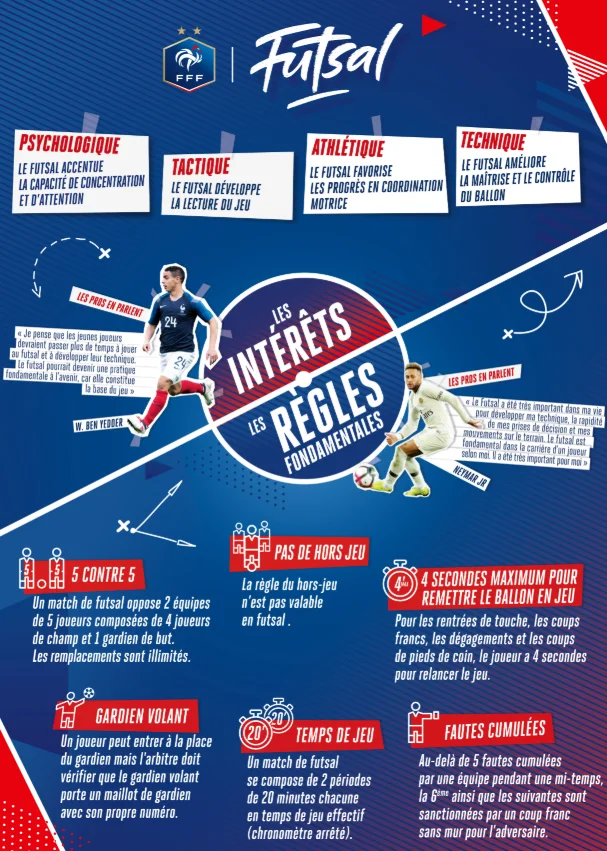
Breaking the 4-second rule leads to specific sanctions, usually the loss of possession to the opposing team. How play restarts depends on the original situation.
- Goalkeeper exceeding 4 seconds in their own half: an indirect free kick is awarded to the opposing team, taken from where the ball was when the offence occurred. If the offence happens inside the goalkeeper’s penalty area, the indirect free kick is taken on the penalty area line, at the point nearest to where the offence occurred.
- Kick-in not taken within 4 seconds: possession is reversed and a kick-in is awarded to the opposing team at the same spot.
- Corner kick not taken within 4 seconds: under the FIFA Laws of the Game, an indirect free kick is awarded to the opposing team. Some local or older interpretations awarded a goal clearance, but the FIFA directive prevails.
- Free kick not taken within 4 seconds: an indirect free kick is awarded to the opposing team, from where the original free kick should have been taken.
- Goal clearance not taken within 4 seconds: an indirect free kick is awarded to the opposing team, generally taken on the penalty area line at the point nearest to where the goalkeeper should have released the ball.
The following table sums up these situations and sanctions:
Summary table: where the 4-second rule applies and the sanctions
| Situation | Sanction if 4 seconds are exceeded |
| Goalkeeper (in possession in own half, hands or feet) | Indirect free kick to the opposing team |
| Kick-in | Kick-in to the opposing team |
| Corner kick | Indirect free kick to the opposing team |
| Free kick (direct or indirect) | Indirect free kick to the opposing team |
| Goal clearance | Indirect free kick to the opposing team |
The fact that the sanction is mostly an indirect free kick or a simple change of possession reflects a particular refereeing philosophy. These sanctions are dissuasive enough to make teams respect the rule, but they avoid giving an attacking advantage that is too direct and potentially disproportionate, such as a penalty.
The underlying aim is to punish time-wasting while encouraging play to restart quickly, which fits perfectly with futsal’s pursuit of fluidity. Harsher sanctions could paradoxically break up the game even more, against the very spirit of the rule.
IV. Refereeing the 4-second rule: procedure and signals
Rigorous, consistent application of the rule depends entirely on the referees’ vigilance and communication. Their role is central to keeping the tempo the rule imposes.
The most distinctive procedure is the visible count. The referee raises one arm above their head and uses the fingers of that hand to count off the seconds, from one to four. The gesture must be clear and obvious to everyone.
A crucial point, and a frequent source of confusion, is when the count starts. The referee starts counting when the player is in a position to play the ball, the ball is stationary and correctly placed, and all the conditions for the restart are met (for example, the opponents are at the required 5 metres). The referee must judge that the taker is “ready” or, conversely, that they are taking too long to get into position. If a player asks the referee to enforce the distance, the count is paused, the referee intervenes and the count resumes where it stopped.
The referee’s communication is not limited to the count. They also use clear signals to show the distance the opponents must respect (often a hand with fingers spread to signal 5 metres). This proactive communication is essential. The visible, systematic count is not a mere formality.
It is a transparency tool: it tells the player how much time they have left and justifies the decision if the time runs out. It also lets the opposing team anticipate and get ready. By making time “tangible”, the referee keeps up constant pressure for a quick restart, in line with the purpose of the rule.
V. Impact on the game: tempo, intensity and strategy
The 4-second rule is much more than a way of measuring time; it is a real engine that shapes futsal’s unique character. Its influence is felt on several levels, contributing directly to the high tempo, quick transitions and constant intensity that make the sport such a spectacle. Every second on the court is used, making every phase of play important and strategic.
This permanent time pressure pushes players towards quick decision-making and greater technical precision. On a small court where reaction time is already limited, the 4-second rule heightens the need to think and act fast. It rewards game intelligence, peripheral vision, anticipation and the technical quality to execute the right move under pressure. Players must develop skills such as close control and instant decision-making.
As a direct result, the rule significantly reduces dead time and increases effective playing time. Unlike other sports in which stoppages can drag on, futsal keeps up a steady rhythm, largely thanks to this rule.
Beyond simply speeding up the game, the rule imposes a continuous cognitive and physical load. Futsal is already a sport of high-intensity intermittent efforts with very frequent changes of activity. The 4-second rule adds to this demand by drastically limiting moments of recovery or reflection at set pieces or when the goalkeeper has the ball. Players must therefore constantly analyse the game, anticipate options and be ready to act instantly.
This constant time pressure on decision-making (the cognitive side) and execution (the physical side) means there is little respite, which adds to fatigue but also produces more complete players, mentally sharper and able to perform at a high level under constraint.
VI. Exploiting and managing the 4-second rule: tactical aspects
The 4-second rule is not just a constraint to put up with; it is also a parameter that smart teams try to exploit tactically, in attack and in defence.
A. In attack: the art of calculated haste
At set pieces (corners, kick-ins, free kicks), the four-second limit demands quick, well-rehearsed combinations. There is no room for haphazard improvisation. Teams must work on specific routines built on perfect timing to surprise the defence.
The first pass and first movement are crucial to create an immediate opening or shooting chance. Quick-thinking players with fast technical execution become major assets in these situations. Overly complex combinations are often ruled out in favour of more direct, incisive patterns.
B. In defence: turning the constraint into an opportunity
Conversely, the rule gives defending teams a chance to win the ball back. High, immediate pressing strategies can harass the ball carrier and force a mistake. This is especially true when the goalkeeper restarts in their own half or when the opponents take kick-ins in their defensive zone.
The aim is to cut passing lanes, isolate the ball carrier and push them into a hasty decision or poor execution under the pressure of the referee’s visible count, which then becomes a defensive “ally”. See our guide to pressing.
C. The special case of the flying goalkeeper (power play)
When a team uses a flying goalkeeper to create a numerical advantage in attack, the 4-second rule affects how it is set up. The outfield player acting as goalkeeper (or the goalkeeper themselves) must quickly cross the halfway line into the opposing half. Once in the attacking half, they are treated as an outfield player and the 4-second limit on possession no longer applies to them there. However, the rule still applies until they reach that zone after winning the ball in their own half. See our analysis of the power play.
This severe time constraint is a real driver of tactical innovation. It pushes coaches to design ever more ingenious set-piece combinations and ever more coordinated pressing patterns.
It also favours the emergence of specialist players who excel under this specific pressure: quick, accurate set-piece takers, sharp distributors, or intelligent defenders skilled at pressing and anticipating the count. Changes to the rules, such as those concerning the standing foot at set pieces, interact with this basic rule and keep tactical approaches evolving.
VII. Common mistakes and practical advice
Despite its apparent simplicity, the 4-second rule is often misinterpreted or forgotten, by players and coaches alike. Good understanding and rigorous application can make the difference.
A. Traps to avoid: frequent misunderstandings
One of the most common mistakes concerns exactly when the referee’s count starts. Many think it begins as soon as the ball goes out of play or stops. In fact, as explained above, the referee only starts counting when they consider the player ready to take the restart and the conditions are met.
Another frequent source of confusion is how the 4-second rule interacts with the goalkeeper’s “second touch” rule. A goalkeeper may not touch the ball again in their own half after playing it (for example, after a pass to a team-mate) unless an opponent has touched it in between or the ball has gone out of play.
The 4-second rule applies to each legal period of possession by the goalkeeper, but the second-touch restriction is a separate rule that can be broken even if four seconds have not passed on that new (and illegal) possession.
Finally, players sometimes forget that the opponents must be 5 metres away before the count can really bind the set-piece taker, or they underestimate how fast the referee counts.
B. Advice for players: mastering time
To manage this constraint effectively, players need to develop several qualities:
- Vision and anticipation: it is crucial to know where and how to play the ball before even receiving it, or before the referee signals the restart.
- Communication: clear, short, quick calls to show passing options or movements are essential.
- Technical mastery: directional first touches that set up the next pass, and quick, accurate passing, win precious fractions of a second.
- Mental strength: staying calm and clear-headed under the pressure of the count is vital to avoid technical errors or poor choices.
C. Advice for coaches: building the rule into training
Coaches have a key role in preparing their players for this feature of futsal:
- Specific drills: systematically include the 4-second count in possession drills, set pieces and goalkeeper distribution. The coach or another player can play the referee. Goalkeeper distribution drills under this constraint are particularly useful.
- Game scenarios: work on fast attacking transitions after winning the ball when the opponents break the 4-second rule.
- Mental work: put players under time pressure to get them used to making quick, correct decisions.
Beyond its regulatory and tactical role, the 4-second rule is a powerful hidden teaching tool. From a very young age, futsal players face this demand for speed. To succeed, they naturally develop faster decision-making, better awareness of space and time, and greater technical efficiency.
Unlike sports with longer moments for reflection, futsal, through this rule, “educates” its players in a particular style of play and in the mental and technical qualities that go with it. Building the rule into training sessions reinforces this idea of skills developed through the very constraints of the game.
Conclusion
The 4-second rule goes far beyond its status as a simple article in the rulebook. It is the invisible metronome that sets futsal’s frantic tempo and one of the main ingredients of its intensity and appeal. It embodies the philosophy of a sport that values effective playing time, speed of execution and situational intelligence.
Understanding where it applies, from the goalkeeper to the various restarts, knowing the sanctions for breaking it, grasping the refereeing procedure and appreciating its deep tactical implications are all keys to decoding the complexity and richness of futsal. See also our guides to accumulated fouls and the futsal glossary.
For players, coaches, referees and even spectators, a thorough knowledge of this rule not only avoids mistakes and frustration, but also lets you fully appreciate how it shapes every action, every transition and, ultimately, the unique beauty of this sport. Watching the 4-second rule in action is touching the very essence of futsal.