
Fouls and accumulated fouls in futsal
Five direct fouls per half, then a kick from 10 metres with no wall: how accumulated fouls work in futsal, which fouls count, and how teams manage the limit.
In this article · 8 chapters
- Understanding fouls in futsal: the basics
- The accumulated-foul system: a futsal speciality
- Disciplinary sanctions: yellow and red cards
- Test your knowledge: futsal fouls quiz
- Quiz: do you know the futsal foul rules?
- Strategy and foul management in futsal
- Frequently asked questions (FAQ)
- Conclusion: more than a rule, a strategic tool
In futsal every second counts, every duel is intense and the smallest mistake can be costly. At the heart of this intensity is a complex but crucial set of rules: how futsal fouls are managed. Understanding the difference between an ordinary foul and an accumulated foul is not just a matter of rules; it is the key to decoding the strategy, the tension and the tactical genius of this sport. An accumulated foul is a foul punished by a direct free kick which, once the limit of five per half is reached, triggers a feared sanction: a direct free kick from the 10-metre mark.
Understanding fouls in futsal: the basics
To master the foul rules in futsal, you need to separate the two main categories of sanction that follow an offence. This distinction is fundamental because it determines whether or not a foul is added to the team’s accumulated-foul count.
What is a direct foul?
A direct foul is an offence committed in a way judged to be careless, reckless or using excessive force. These are the most common fouls and are considered the most serious in terms of play.
All direct fouls count as accumulated fouls.
These are the actions that lead to a direct free kick (and therefore an accumulated foul):
- Kicking or attempting to kick an opponent.
- Tripping or attempting to trip an opponent.
- Jumping at an opponent.
- Charging an opponent.
- Striking or attempting to strike an opponent.
- Pushing an opponent.
- Tackling an opponent (the sliding tackle is forbidden in futsal, except for the goalkeeper in their own penalty area).
- Holding an opponent.
- Spitting at an opponent.
- Deliberately handling the ball (except for the goalkeeper in their own penalty area).
Quote: “Managing direct fouls is an art. A team that commits too many fouls early in a half exposes itself to immense pressure and hands golden chances to the opponent.”
What is an indirect foul?
An indirect foul is an offence that usually involves no direct contact or blatant foul play. Play is stopped, but the free kick cannot be shot directly at goal. The ball must touch another player before a goal can be scored.
Indirect fouls do NOT count as accumulated fouls.
Situations leading to an indirect free kick include:
- Playing in a dangerous manner (for example, a high foot near an opponent’s face without touching them).
- Impeding an opponent’s progress without contact (blocking their path).
- Preventing the goalkeeper from releasing the ball.
- For the goalkeeper, committing one of the following offences:
- Controlling the ball with the hands or feet for more than four seconds in their own half. This is the famous 4-second rule in futsal.
- Touching the ball again in their own half after releasing it, before an opponent has touched it.
The accumulated-foul system: a futsal speciality
The concept of accumulated fouls is what makes defensive discipline so critical in futsal. It is a rule that rewards disciplined teams and severely punishes those that keep making mistakes.
The 5-foul limit: the threshold not to cross
The principle is simple:
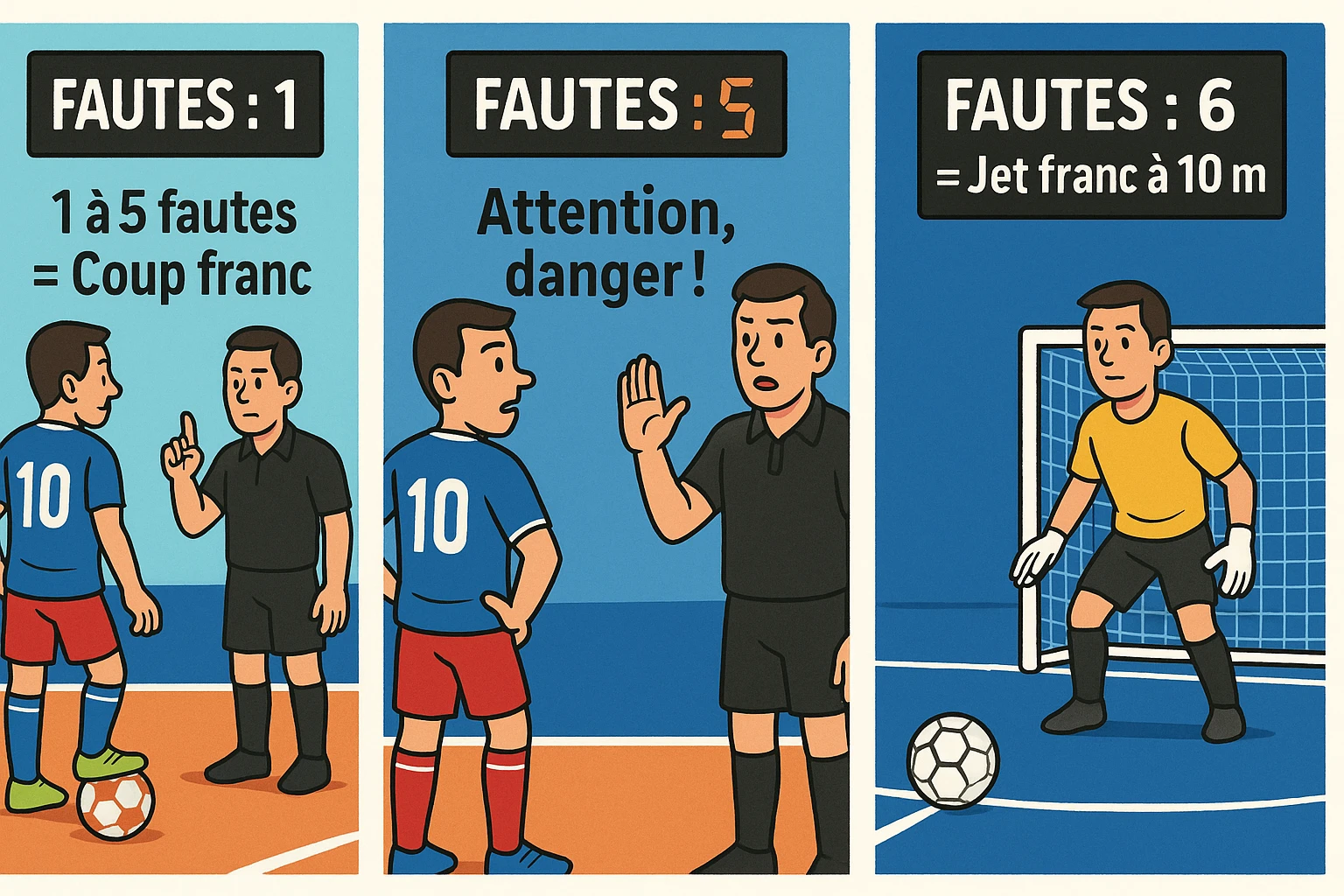
- Each team can commit up to five direct fouls per half without any extra penalty (other than the free kick itself).
- The referee clearly signals when a team’s count reaches its 5th foul.
- From the sixth direct foul (and for every following one in the same half), the offending team is punished by a direct free kick from the 10-metre mark.
The count is reset at the end of the first half. However, if the match goes to extra time, the second-half count is not reset: extra time is treated as a continuation of the second half.
The 10-metre kick
This is one of the most feared sanctions in futsal. Here is how it works:
- Placing the ball: the ball is placed on the second penalty mark, 10 metres from the goal.
- No wall: the kicker faces the goalkeeper alone. No defensive wall is allowed.
- Players’ positions: all other players (team-mates and opponents) must be behind an imaginary line level with the ball and at least 5 metres away.
- Goalkeeper’s position: the goalkeeper must stay on the goal line until the ball is kicked. They may move sideways.
If the direct foul is committed closer to goal than the 10-metre mark (but outside the penalty area), the team awarded the free kick can choose to take it from where the foul happened or from the 10-metre mark.
The 6-metre penalty
The 10-metre kick should not be confused with the “classic” penalty. A 6-metre penalty is awarded when a direct foul is committed inside the offending player’s own penalty area, whatever the number of fouls accumulated by their team. This foul also counts as an accumulated foul.
Disciplinary sanctions: yellow and red cards
As well as free kicks and accumulated fouls, referees have cards to punish unsporting behaviour and serious fouls. These sanctions are separate from the foul count.
The yellow card (caution) 🟨
A player receives a yellow card for:
- Unsporting behaviour.
- Dissent by word or action.
- Persistent infringement of the Laws of the Game.
- Delaying the restart of play.
- Failing to respect the required distance at a corner kick, free kick or kick-in.
The red card (sending-off) 🟥
A player is sent off (red card) for any of the following offences:
- Serious foul play (endangering an opponent’s safety).
- Violent conduct.
- Spitting at an opponent or anyone else.
- Denying an obvious goal-scoring opportunity with a foul punishable by a free kick.
- Denying an obvious goal-scoring opportunity by deliberately handling the ball.
- Receiving a second caution (yellow card) in the same match.
When a player is sent off, their team plays a player short for two full minutes, or until the opposing team scores. After the two minutes (or the goal), another player may come on. The rules on substitutions in futsal are very fluid, but a sending-off has a major tactical impact.
Test your knowledge: futsal fouls quiz
Think you have understood everything? This interactive tool will help you test your knowledge of futsal foul rules in real match situations.
Quiz: do you know the futsal foul rules?
Strategy and foul management in futsal
Foul management is not just a constraint; it is a tactical element in its own right. Coaches and players must keep it in mind at all times to adjust their strategy.
The art of the “smart foul”
Early in a half, when a team’s foul count is clean, committing a “smart” or “tactical” foul can be a winning strategy. The idea is to illegally stop a dangerous counter-attack far from your own goal.
- Advantage: it breaks the opponent’s momentum and gives your own team time to get back into defensive shape.
- Risk: the player may get a yellow card, but the tactical benefit is often judged worth the risk, especially when the foul count is at 0 or 1.
Handling the pressure near the 5-foul limit
When a team reaches 4 or 5 accumulated fouls, the match changes.
- A change of defensive style: defenders become much more cautious. They avoid committed duels and tackles, favouring interceptions and positioning so as not to concede the fateful 6th foul.
- Psychological pressure: the constant threat of the 10-metre kick weighs on players, who can become hesitant.
- An advantage for attackers: opposing attackers know this and do not hesitate to provoke, dribble and take on their direct opponents, knowing they are more reluctant to foul. A good strategy for pressing while outnumbered (FR) or at 5 v 5 must take this into account.

Frequently asked questions (FAQ)
1. Does a foul in the penalty area count as an accumulated foul?
Yes. If a direct foul is committed in the area, it leads to a penalty (a kick from 6 metres) AND it is added to the team’s accumulated-foul count.
2. What happens if a foul is committed during extra time?
Extra time is treated as a continuation of the second half, so the accumulated-foul count is not reset. If a team had 4 fouls at the end of normal time, it starts extra time with those 4 fouls.
3. Can the referee play advantage on an accumulated foul?
Yes. The referee can let play continue if the fouled team benefits from an advantage (for example, a clear goal-scoring chance). If the advantage does not materialise, they can go back to the original foul. Once the foul is given, it is added to the count.
4. Are all goalkeeper fouls indirect?
No. Goalkeeper-specific offences (such as holding the ball for more than 4 seconds) are indirect. But if a goalkeeper leaves their area and commits a “classic” foul such as a trip or a deliberate handball, it is punished by a direct free kick and counts as an accumulated foul.
Conclusion: more than a rule, a strategic tool
Futsal fouls and the accumulated-foul system are far more than a line in the Laws of the Game. They shape the rhythm, the tension and the strategy of every match. For players, discipline and defensive intelligence are as vital as dribbling technique or shooting power. For spectators, understanding this mechanism lets you fully appreciate the tactical choices, the psychological pressure and the twists that make the sport so gripping.
Next time you watch a match, keep an eye on the foul count on the scoreboard. You will see much more than numbers: you will read the hidden story of the match. To go further and discover the finer points of the sport, explore the other guides in our futsal guide.