The complete guide to the “Y” defence (1-1-2) in futsal, with Osmar Fonnegra
Two players high, one floating, one last man: Colombian coach Osmar Fonnegra breaks down the Y defence, its pressing triggers, its traps and the situations in which you must never use it.
In this article · 8 chapters
- I. The philosophical and teaching foundations of defending
- II. Fundamental principles of defensive tactics
- III. The “Y” (1-1-2) defensive system: an in-depth analysis
- IV. Detailed technical scenarios
- V. Teaching it: from youth to professionals
- VI. Tactical summary: the checklist
- VII. FAQ: advanced questions about the “Y” defence
- Conclusion: towards a higher tactical culture
Introduction: defensive excellence as a pillar of modern futsal
Futsal is not just a game of speed; it is a discipline of cooperation and opposition in which spatial structure and timing decide who wins. In this in-depth resource, we draw on the expertise of Osmar Fonnegra, an iconic figure of Colombian futsal, and his international coaching team (Mauricio Suárez, Matías, David Jiménez, Luis Enrique).

This article is not a simple summary. It is a deep dive into defensive systems, and in particular the “Y” defence (or 1-1-2). We will break down every movement, every tactical intention and every common mistake to transform your understanding of the game. The promise is simple: after reading this, the complexity of high zonal defending will hold no secrets for you.
I. The philosophical and teaching foundations of defending
Before looking at the geometry of the court, you need to understand the mindset required for defensive excellence. According to Professor Fonnegra, defending is a question of will and resilience.
1.1 The human dimension and resilience
Sport is a mirror of life. Osmar Fonnegra stresses the importance of mental strength, illustrated by his own fight against COVID-19. For him, a team that defends well is a family. Solidarity on the court is an extension of human solidarity. If one player does not sacrifice themselves for a team-mate, the system collapses.
1.2 “Learning to run backwards” (aprender a correr hacia atrás)
One of the most important teaching points is his criticism of “lazy” players. Many players are technically gifted on the ball but become stubborn tactically as soon as they have to defend.
- The fatigue myth: Fonnegra denounces a major inconsistency: a player who sprints flat out to attack in the 39th minute but claims to be too tired to track back on the counter-attack.
- Non-negotiable intensity: intensity in training must be double that of the match. As Diego Giustozzi (Argentina’s world champion coach, quoted by Fonnegra) says, intensity is the foundation of all tactical success.
1.3 Communication: beyond words
Communication is not just shouting. In noisy sports halls, it becomes:
- Visual: a look, a body position.
- Well-timed: it must happen before the action (anticipation), not after the mistake.
II. Fundamental principles of defensive tactics
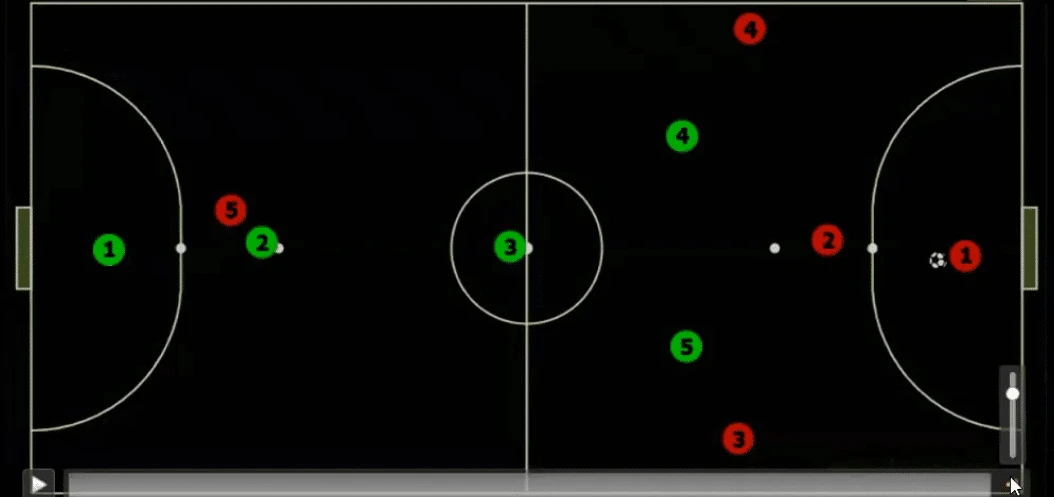
For a “Y” system to work, the basic principles must be obsessively absorbed by every member of the quartet.
2.1 The line of the ball (la línea del balón)
This is an absolute rule: all four players must always be behind the line of the ball.
- Aim: avoid being outnumbered and force the opponent to play in non-critical areas.
- Systematic reorganisation: as soon as the ball gets past a line, players must drop back immediately to re-form the block.
2.2 Protecting the middle and using the touchlines
Modern futsal sees the central axis as the deadliest danger zone.
- Nothing through the middle: the defence must close the inside passing lanes.
- Show them wide: invite the opponent to play down the flanks. Why? Because the shooting angle is reduced there and the touchline acts as a “fifth defender”.
- Body shape: foot position is crucial. If the opponent is right-footed, the defender must position themselves to close off the stronger foot and steer the attacker onto the weaker leg or towards the touchline.
2.3 Defensive transition: the end of pure man-marking
Fonnegra is categorical: old-fashioned strict man-marking is obsolete.
- Cooperation and support: if my team-mate is beaten, I cannot say “not my player”. High-level sport demands constant cover (coberturas) and support.
- The provoked mistake: you do not press only to steal the ball, but to provoke a technical error (a bad pass, the ball out of play, an illegal pass back to the goalkeeper).
III. The “Y” (1-1-2) defensive system: an in-depth analysis
The “Y” system (often called 1-1-2, or pointed pressure) is an aggressive high-pressing strategy.
3.1 Geometric structure
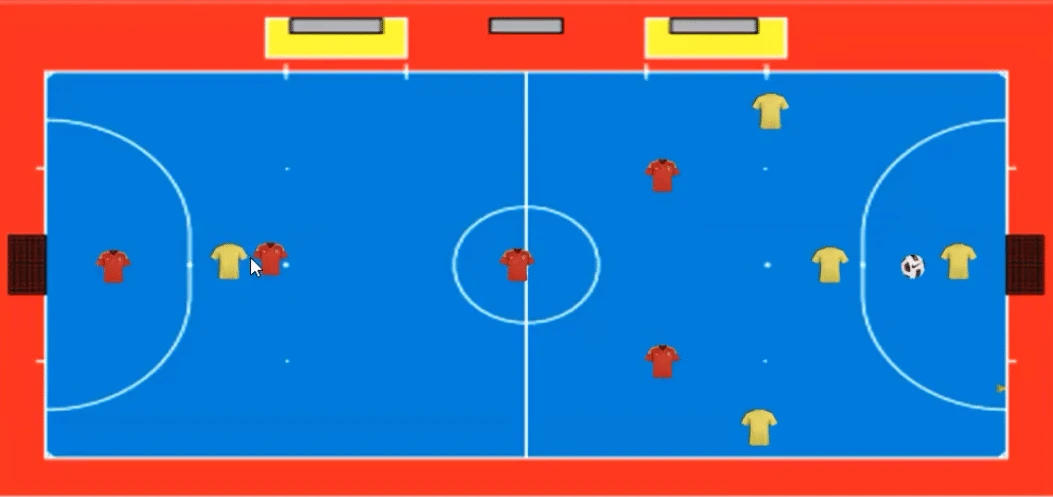
- The first line (the arms of the Y): two players high up, usually between the 10-metre mark and the centre circle.
- The second line (the centre of the Y): one player who floats, ready to shift from side to side to close central passing lanes.
- The last man, or “cierre” (the base of the Y): one player positioned in front of the opposing pivot, managing the depth.
3.2 Spatial constraints (40 × 20)
Note: this system is designed for a regulation 40 × 20-metre court.
- On a smaller court (30 × 18 or 32 × 20), space is too tight and a single dribble can take out the whole block.
- On a big court, the “Y” defence lets you set traps, using the distances to tire the ball carrier.
3.3 The goalkeeper’s role (portero-líbero)
In the “Y” defence, the goalkeeper is no longer a spectator on the line.
- Reading the long ball: if the opposing goalkeeper tries to bypass the lines to find their pivot, the goalkeeper must be ready to leave the area and act as a covering defender.
- Communicating with the “cierre”: the goalkeeper tells the last defender where the pivot is when the defender cannot see them.
IV. Detailed technical scenarios
From the tactics-board exercises, we can detail how the system reacts in specific situations.
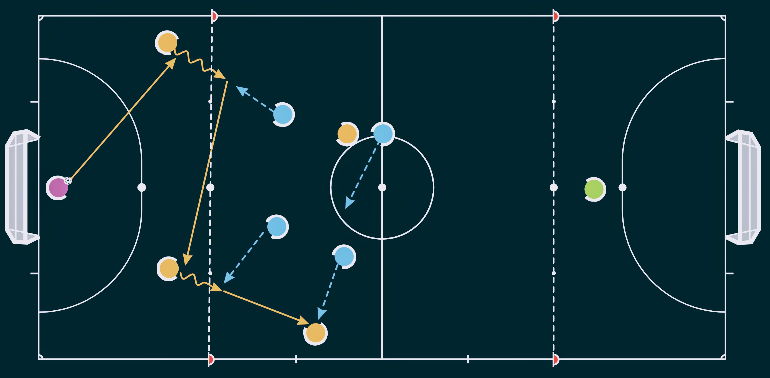
4.1 Pressing after the “third touch”
You do not press as soon as the opposing goalkeeper has the ball (that would be tactical suicide).
- The trap (the “dulcecito”): let the opponent exchange one or two square passes so they gain confidence and step forward.
- The trigger: on the second or third touch, the intensity suddenly goes up to 100%. The aim is to smother the ball carrier just as they look for a forward option.
4.2 Ball on the wing: forming the triangle (or cone)
When the ball reaches a flank:
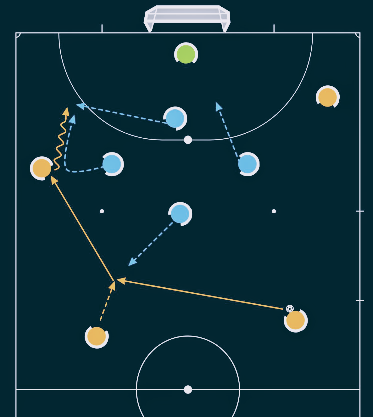
- Direct pressure: the nearest player (the arm of the Y on that side) closes the forward angle.
- Central cover: the central player of the Y moves across to cut the cross-court pass.
- The defensive triangle: the three players nearest the ball form a compact triangle. The fourth (on the far side) tucks in towards the middle for balance.
- Detail: if the opponent tries a “parallel” pass (along the line), the central player must have anticipated it to intercept.
4.3 Dealing with the opposing pivot (the 1v1 duel)
The last defender (cierre) often plays in front of, or in contact with, the pivot.
- Anticipation: if the ball is played over the top, the cierre must not be lobbed.
- The defensive diagonal: if the pivot drifts towards the wing, the cierre follows up to a point, then swaps with the winger so as not to leave the middle empty.
4.4 Common mistakes and things not to do
- Against a 4-0 (four players in a flat line): never use the “Y”. Why? Because it leaves too much space on the flanks. A team playing 4-0 will easily get past the arms of the Y with in-and-out movements. See our guide to the 4-0 system.
- Against the power play (5 v 4): the “Y” is ruled out. When outnumbered, the defence must drop into a “box” (square) or a “diamond” to protect the heart of the area. See the power play and the low block diamond.
V. Teaching it: from youth to professionals
How do you teach such a complex system? Osmar Fonnegra proposes a structured approach.
5.1 Why not for children?
The professor is clear: the “Y” system is not recommended for beginners (ages 7–12).
- Cognitive complexity: it requires spatial and temporal coordination that children have not yet developed.
- Simplicity first: with young players, teach basic man-marking and the idea of “always behind the ball” first. See our guide to futsal for children.
5.2 The integration strategy (“sowing seeds”)
For older youth categories (ages 14–17):
- Mixing: bring 2 or 3 young players into training with seniors who already master the system.
- Learning by osmosis: the youngsters learn by watching the pressing triggers and cover of more experienced players, then take that know-how back to their own age group.
5.3 Case study: Richard Ríos
Fonnegra mentions Richard Ríos (formerly of Flamengo in Brazil), a perfect example of futsal technical development applied to top-level football. It shows that futsal’s tactical rigour (small space, quick decisions) produces superior athletes. Read more on how futsal shapes football talent.
VI. Tactical summary: the checklist
Checklist for the perfect “Y” defence
| Criterion | Check |
|---|---|
| Regulation court (40 × 20 m)? | ✔ |
| Are all 4 players behind the line of the ball? | ✔ |
| Press triggered on the 2nd or 3rd touch? | ✔ |
| Obsessive closing of the middle? | ✔ |
| Is the goalkeeper ready to act as a sweeper? | ✔ |
| Body shape steering towards the touchline? | ✔ |
VII. FAQ: advanced questions about the “Y” defence
1. Can the “Y” system be used against a kick-in?
Osmar Fonnegra’s answer: no. On a kick-in, the opponent can use their goalkeeper as an immediate outlet, which breaks the structure of the Y. In that case, go back to more traditional zonal or man-marking behind the line of the ball.
2. Who is the most important player in this system?
The “central” player of the Y (the second line). They need exceptional reading of the game to know when to step up and press with the two arms and when to drop back to help the last man. They are the team’s tactical lungs.
3. What if the opposing attacker manages to turn with the ball?
The instruction is to drop back immediately (run backwards). Abandon the high press and re-form a defensive square (around the 6-metre area) to protect the goalkeeper and wait for a new chance to press.
4. How do you deal with a very powerful pivot?
The last man must not rely on strength alone, but on anticipation. The “Y” helps because the three players in front press the passer, making the pass into the pivot less accurate and easier to intercept.
5. Is it a tiring system?
Extremely. It requires elite fitness. That is why Fonnegra recommends frequent rotations (changing quartets) to keep the pressing intensity at its maximum. See our guide to substitutions.
Conclusion: towards a higher tactical culture
The “Y” defence is much more than a shape on the court; it is a commitment to excellence. As Osmar Fonnegra stressed throughout his talk, success lies in the details: body position, visual communication, the discipline to run backwards and rigorous analysis of the opponent.
As coaches or players, do not just “copy and paste” (as Mauricio Suárez put it). Make these concepts your own, test them, and never forget: “what you hear, you forget; what you see, you remember; but what you do, you learn.” The futsal of tomorrow belongs to those who master the art of defending intelligently.