Defensive excellence in futsal: individual and collective principles
Defence is the beating heart of a team: the individual and collective principles of Argentine coach Emanuel Santoro, from stance to saltos, with a checklist for your next match.
In this article · 9 chapters
- I. The model’s identity: why defence defines success
- II. Individual fundamentals: “micro-tactics”
- III. Collective principles: building the wall
- IV. Advanced mechanics: switches and jumps (saltos)
- V. Training methodology: forging the mindset
- VI. The importance of transitions
- The elite defender’s checklist
- VII. FAQ: the expert’s questions
- Conclusion
This guide breaks down the individual and collective defensive principles of modern futsal, based on the teaching of Emanuel Santoro, an Argentine coach and one of the leading voices of the Argentine school.
Modern futsal is no longer won only through attacking talent or dribbling ability. As Santoro puts it, defence is the beating heart of a team: its backbone and its true identity. In this guide we break down the technical details, tactical nuances and mental foundations that turn a vulnerable team into a wall that is very hard to get through.
It is more than a summary: it is a dive into the methodology of the Argentine school, world champion in 2016, whose ideas are widely shared in the Spanish league (LNFS), often considered the strongest in the world.
I. The model’s identity: why defence defines success
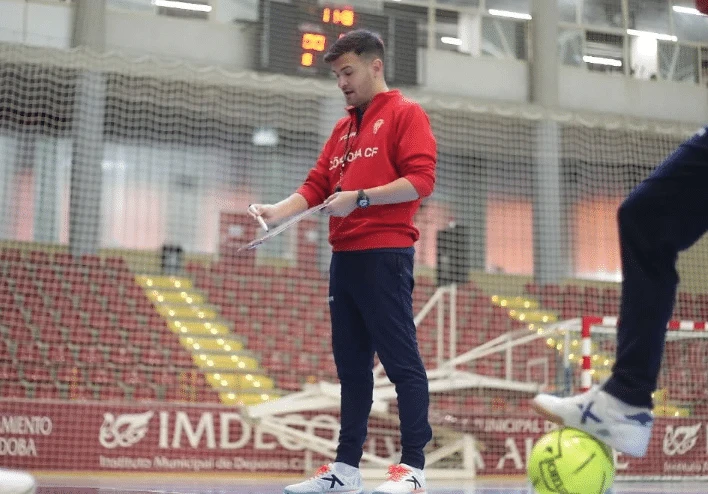
Before getting into pure tactics, it is crucial to understand the philosophy behind the movement. The Argentine model, of which Santoro is one of the best-known representatives, rests on three behavioural pillars that come before technique:
- Commitment and competitiveness: the willingness to sacrifice yourself for the team (“throwing yourself head first for a team-mate”).
- Resilience in adversity: knowing how to suffer when the opponent dominates, the better to bounce back.
- Adaptability: being able to switch from a high defence to a mid-block depending on the match situation.
The concept of “cooperative defence”
Contrary to a common belief, defence is not a sum of individuals. Santoro rejects the “superhero” who tries to win the ball alone by diving to the floor. Defence is cooperative: a first line presses to force a bad pass, allowing the second line to intercept. If one link breaks, the system must absorb the error through automatic cover.
II. Individual fundamentals: “micro-tactics”
The quality of a collective system depends on individual rigour. Santoro identifies four pillars that every player must master obsessively.
1. Defensive stance (centre of gravity)
Stance is not about looks, it is functional. Santoro’s image: a player standing upright “as if in a queue” covers about 40 cm, while a player in the right stance covers around 1.5 m of passing lanes.
- Technique: knees bent, low centre of gravity, weight on the balls of the feet (never on the heels).
- Aim: to be permanently alert, ready to react to explosive changes of direction.
- Orientation: the defender uses their body to steer the attacker towards the chosen areas (usually the touchline, the banda).
2. “Viajes agresivos” (aggressive journeys)
The viaje (journey) is the defender’s movement while the ball travels between two attackers.
- The golden rule: close the distance while the ball is travelling. If the defender waits for the attacker to receive before moving, they have already lost the time advantage.
- Technical nuance: the approach must be aggressive but controlled, so you are not beaten by a directional first touch.
3. Safety distance: managing space
This is probably the most neglected concept, even at the top level. The safety distance is the optimal space between the defender and an attacker without the ball.
- Why: if you are too tight, the attacker will beat you in behind with a sudden burst (the back-door run). If you are too far away, you cannot press when they receive.
- How far: about 1.5 metres (an arm’s length). The arm acts as a feeler to sense the opponent’s movement without losing sight of the ball.
- Fatal error: losing sight of your direct opponent by staring at the ball. Vision must be peripheral (ball, team-mate, opponent).
4. Recovery runs (repliegue)
Getting back is pure willpower. As soon as the ball is lost, all four outfield players must sprint flat out behind the line of the ball.
- Aim: to prevent numerical disadvantages (2 v 1 or 3 v 2).
- Mindset: “If we have to make 50 recovery runs in a match, we make them.” That is the price of being competitive.
III. Collective principles: building the wall
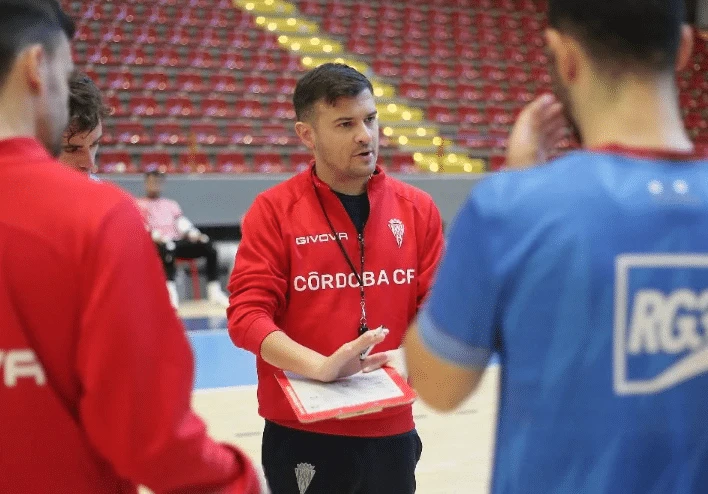
Once the individual basics are in place, Santoro puts the pieces together to create an individual system with switches and jumps (saltos).
1. A three-line structure (the triangle)
Whatever the opponent’s system (3-1 or 4-0), the defence must always organise itself in lines of cover.
- First line: the players pressing the ball carrier.
- Middle line: the player closing diagonals and passes inside.
- Last line (the cierre): the player providing final cover and dealing with the opposing pivot.
- The defensive triangle: when the ball is steered towards one wing, the far-side player must tuck inside to form a triangle, providing security if the first line is broken.
2. Heavy pressure on the banda (touchline)
The court is an ally: the touchline is the “fifth defender”.
- The trap: let the opponent play the first pass (progressive pressure from around 28 metres) to lure them towards the wing.
- The trigger: as soon as the ball reaches the wing, the pressure becomes maximal. The aim is to smother the attacker, stop them turning and force them to play back or lose the ball.
3. The answer to the 4-0: adjusting on the first corte
In modern futsal, the 4-0 (four players flat) aims to break defences that switch automatically. Santoro proposes a radical solution: individual adjustment on the first movement.
- The principle: do not switch marking automatically on the first crossing run. The defender follows their player (keeping the safety distance) until the ball is genuinely under pressure.
- The advantage: it avoids opening gaping holes that attackers could exploit with a chipped pass or a short paralela.
Read our article to understand the 4-0.
IV. Advanced mechanics: switches and jumps (saltos)
Santoro’s system is not a passive zone defence; it is an intelligent harassing defence.
1. Visual switches (non-verbal communication)
At the elite level, the noise is such that you cannot rely on shouting (“Switch!”, “I’ve got mine!”). Communication must be visual.
- Every player must read their team-mates’ positions. If I see my partner is beaten, or that a switch would keep the pressure on more effectively, I make it by visual anticipation.
2. Types of saltos (defensive jumps)
The salto means leaving your own player to jump onto another ball carrier, in order to keep the block high.
- Proximity salto: am I closer to the new ball carrier than my team-mate? I jump to press, and my team-mate covers behind.
- Odd-number salto (2 v 3): a complex technique in which two defenders handle three attackers high up the court to avoid dropping off.
- Salto on a back pass: as soon as the ball goes backwards, it is the signal to jump and push the opponent back towards their own goalkeeper.
V. Training methodology: forging the mindset
For Santoro, tactics without teaching are useless. He uses three key concepts to run his sessions:
- Competitiveness: every drill must have a winner and a loser. “Losing the ball has to hurt, even in training.”
- Conviction: players must understand why they make each movement. Video is an essential tool to show successes and mistakes.
- Joy (alegría): despite the extreme demands, the climate must stay positive. Defending is an act of solidarity that deserves to be celebrated.
A typical training week
- Monday: recovery, video analysis, low physical load.
- Tuesday: small-sided situations (2 v 2, 3 v 3) focused on individual concepts (stance, journeys).
- Wednesday: full-court work (4 v 4) focused on attack and transitions.
- Thursday and Friday: specific tactics for the next opponent (scouting).
VI. The importance of transitions
Match analysis in elite futsal points the same way: a large share of goals come from transitions (changes of possession).
- Top teams such as Barça are particularly dangerous in transition.
- That shows that defending is attacking: by winning the ball high thanks to saltos and pressure on the touchline, you attack a disorganised defence.
The elite defender’s checklist
Use this checklist to assess your players, or your own performance, in your next match. Tick each box when the behaviour is consistently there.
| Concept | Required action | Done |
|---|---|---|
| Stance | Low centre of gravity, weight on the front of the foot. | |
| Viajes | Aggressive movement while the ball is travelling. | |
| Safety | Keep a 1.5 m distance from a player without the ball. | |
| Recovery | All 4 outfield players behind the ball within 3 seconds. | |
| Triangles | The far-side winger closes the inside to cover the pivot. | |
| Saltos | Jump onto the ball carrier if I am the closest. |
VII. FAQ: the expert’s questions
1. Should you always follow the first corte (run), even if it takes you away from the ball?
Yes, as long as the ball is not under so much pressure that a long pass is impossible. Individual adjustment on the first movement means you will not be beaten by a simple paralela. Stability comes before immediate aggression.
2. How do you defend against a dominant pivot who receives every ball?
The key is not only the duel with the last defender (the cierre). The key is pressure on the passer. If the ball carrier has their head down because of your pressure, they cannot find the pivot accurately. If the ball does reach the pivot, the adjustment must be individual: close their turning angles and deny the return pass (facing play).
3. Why not use a pure zone defence?
A zone gives talented players too much time to think. Modern futsal is about reducing space and time. Individual defence with aggressive saltos forces the opponent into technical errors.
4. What if the referee whistles a lot of fouls on our pressing?
Santoro is clear: “You don’t stick your foot in.” Most fouls come from poor stance (balance) or a desperate attempt to win the ball with the hands or by diving in. Good pressing means harassing with the body, not illegal contact.
5. How high should the pressing line be?
It depends on the scouting. Against a team that plays long, drop the line to about 25 m so you do not leave space in behind. Against a team that builds short, push up to about 30 m to suffocate their build-up.
Conclusion
Defence in futsal is not a waiting phase; it is attacking without the ball. Mastering Emanuel Santoro’s principles means accepting that success rests on disciplined stance, intelligent saltos and unwavering solidarity. As the saying quoted by Santoro goes: “Running is a decision of the will; creating takes talent.” By making defence your priority, you put your destiny in your own hands, not only in the feet of your most talented players. See also our guides to the mid-block and to pressing, blocking and interceptions.