The defensive diamond: mastering the low block in futsal
One player in front, two in support, one covering the goal: the 1-2-1 diamond turns the low block into a fortress. How it works and how to train it.
Defence is the backbone of every successful futsal team. A well-organised low block can frustrate opposing attackers and force them into mistakes. This article explores a key defensive strategy: the diamond formation. Developed and inspired by Graeme Dell, this tactical approach aims to control space, stifle attacking initiative and turn defence into a real weapon. Get ready to dive into a tactic that changes the way you defend in futsal!
Understanding the low block and its advantages
The low block is a defensive strategy in which the team positions itself relatively close to its own goal. Its main aim is to reduce the spaces between the lines and make it hard for the opponent to reach shooting areas. It is particularly effective against teams that like to build slowly from the back, and it also helps control the opponent’s counter-attacks.
The low block is not just a defensive posture. It demands rigorous tactical discipline, excellent communication and the ability to anticipate the opponent’s movements. A well-drilled team in a low block can become an impregnable fortress. See also our guide to the mid block.
The diamond formation: a key structure
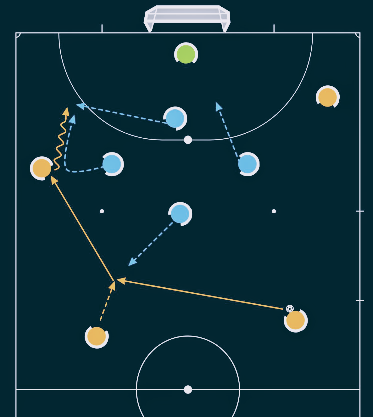
Within a low block, the diamond is a specific arrangement of the defending players. It takes a 1-2-1 shape, in which:
- One player occupies the most advanced point, acting as the first line of defence.
- Two players position themselves in support, forming the heart of the diamond.
- One last player provides cover and protects the goal.
This set-up creates a dense network for intercepting passes and constant pressing. It forces the opponent to play down the flanks, away from the danger zone, with the aim of pushing them into a mistake or a risky pass.
Setting up the drill
To put the formation into practice, here is a simple, effective organisation:
- Court: use the whole court.
- Format: 4 v 4 in one half of the court.
- Shape: the defending team uses the diamond (1-2-1).
- Goalkeepers: one goalkeeper in each team.
- How it works: play starts with the attacking team in possession near its own goal. The attack’s aim is to score; the defence’s aim is to stop the attack from shooting. After a goal or a turnover, roles are reversed and play restarts at the other end.
The essential technical elements
The strategy relies on several technical elements:
- Immediate pressure: as soon as the opponent receives the ball, they must be pressed so they cannot assess their options. Aggressive, coordinated pressing is crucial.
- Showing them wide: forcing the opponent to play down the flanks, away from the middle, greatly reduces their chances of creating dangerous opportunities.
- Anticipation and interception: anticipating the opponents’ runs and the path of passes is essential to intercept the ball and win possession.
- Movement off the ball: players must keep moving to fill gaps and support team-mates. Communication is vital.
- Not backing off: when an opponent starts dribbling, avoid retreating towards your own goal. Instead, try to contain them and force a mistake.
Beyond technique: the importance of team spirit
The diamond formation is not only a question of technique. It also demands strong team spirit and constant communication. Players must read the game, anticipate their team-mates’ movements and adapt to changing situations. A close-knit, well-organised group is the key to success.
As many top coaches, such as José Venancio López, put it: “Defensive cohesion is the result of hard work and mutual trust between players.”
Conclusion: the diamond, a strategic weapon
The diamond formation in a low block is a powerful, effective defensive strategy in futsal. It lets a team control space, frustrate the opponent and turn defence into a real attacking weapon. Using it demands rigorous tactical discipline, excellent communication and strong team spirit. Master it and your team will be ready to take on any challenge.
To learn more about defensive strategies in futsal, read our guide to pressing, blocking and interceptions and explore the Training section.