The toe poke in futsal: the powerful, unpredictable shot
No back-lift, a low trajectory and surprising power: the toe poke is one of futsal's deadliest shots. How to strike it, when to use it and how to train it.
In this article · 9 chapters
- What is the toe poke in futsal? A clear definition
- Why is the toe poke so effective? Its key advantages
- Toe poke technique: mastering the art of the powerful shot
- When to use the toe poke: the ideal situations
- Common mistakes to avoid
- Training your toe poke: drills and exercises
- The toe poke in modern futsal: an essential tactical weapon
- Analysing and improving your shooting: the post-match review
- Conclusion: the toe poke, an essential futsal weapon
Futsal is a dynamic, fast and unpredictable sport. Every pass, every dribble and every shot counts. At the heart of this intensity is a shooting technique that, though sometimes underrated, is incredibly effective: the “toe poke” (or toe-punt, called the “pointu” in French). This shot, struck with the tip of the foot, is a formidable weapon that can surprise the most experienced goalkeepers and ripple the net with unexpected power.
Unlike 11-a-side football, where players prefer to strike with the laces or the inside of the foot, futsal, with its tight spaces and frantic pace, is the ideal setting for the toe poke. Its speed of execution, its often low trajectory and its surprising power make it an essential asset for any player who wants to make a difference. Whether you are an attacker trying to beat the goalkeeper in a flash or a defender looking for a quick shot under pressure, mastering the toe poke can transform your game.
Let us dive into the world of this unique shot to understand why it is so effective, how to master it and how to add it to your tactical arsenal.
What is the toe poke in futsal? A clear definition
The toe poke is a shooting technique in which the ball is struck with the hard tip of the futsal shoe. It is one of the most direct and powerful strikes in the sport. Unlike a classic shot with the instep (the top of the foot) or the inside of the foot, the toe poke uses a very small but very rigid contact surface, which gives the ball a particular speed and trajectory.
Imagine flicking a marble with the tip of your finger: the force is concentrated on a small area, sending the marble off at high speed. The principle is the same. The futsal ball, heavier and less bouncy than a traditional football, is perfectly suited to this kind of strike: its low elasticity transmits the energy of the strike efficiently.
Historically, the toe poke was often seen as a “crude” or “clumsy” shot in 11-a-side football. In futsal, however, it has become a respected, fundamental technique. Why? Mainly because of the nature of the game:
- Tight spaces: players have little time and space to wind up a shot.
- Speed of play: futsal demands ultra-fast decisions and actions.
- Proximity to goal: the goals are smaller and goalkeepers are very close, so shots are often taken at point-blank range.
The toe poke meets these constraints perfectly, offering a quick, powerful and often unpredictable shot. It is a weapon every futsal player should try to master.
Why is the toe poke so effective? Its key advantages
The toe poke’s effectiveness is no myth; it rests on several unique features that set it apart from other shots. Understanding them is the first step to appreciating the technique.
1. Raw power
The toe poke generates phenomenal power with minimal apparent effort. By striking with the tip of the foot, the player concentrates all the energy of the movement on a very precise point of the ball. This produces a fast shot.
“The toe poke turns a small movement into an explosion of power. The ball flies off like a rocket!”
A ball struck this way can reach the goal in a fraction of a second, leaving the goalkeeper little time to react. This power matters all the more in futsal, where shots are often taken from short or medium range.
2. Speed of execution ⚡
This is one of the toe poke’s greatest assets. Unlike a laces shot, which needs a back-lift and swing, the toe poke needs very little preparation. The foot can be almost touching the ball before the strike, allowing near-instant execution.
This “quick trigger” is crucial in tight situations:
- In the penalty area: when a defender is right on you.
- From a quick pass: for a first-time shot.
- On the counter-attack: to surprise the goalkeeper before they are set.
Being able to shoot with no visual warning is a nightmare for goalkeepers and defenders.
3. An unpredictable trajectory
The toe poke is known for its often irregular, unpredictable flight. The ball tends to “float” or “dip” unexpectedly, making the goalkeeper’s job even harder. This is due to several factors:
- Little spin: unlike laces shots, which can put spin on the ball, the toe poke strikes it very directly, reducing spin and making its flight more erratic.
- Low bounce: the futsal ball bounces little, which, combined with the direct strike, can make it deviate slightly off the floor.
- Low trajectory: most toe pokes travel very low, just above the floor. They are hard to stop because they pass under the arms or legs of diving goalkeepers.
4. Less run-up and balance needed
Compared with other shots, the toe poke is more “forgiving” in terms of balance and run-up. It can be struck while slightly off balance or with very little room for a run-up, which makes it ideal when the player is under pressure, surrounded by defenders or falling.
| Feature | Toe poke | Classic laces shot |
|---|---|---|
| Power | High, explosive | High, progressive |
| Speed | Very fast, instant | Needs a back-lift |
| Accuracy | Hard to control | More controllable |
| Trajectory | Low, unpredictable | More predictable, varied |
| Preparation | Minimal | Needs space |
| Wear | Can be hard on the toes | Less direct impact |
Toe poke technique: mastering the art of the powerful shot
Simple as it may look, the toe poke takes practice and a precise understanding of the technique. It is not just “kicking the ball with your toe”, but doing it in a controlled way to maximise power and accuracy.
1. Body position
- Standing foot: place your standing foot next to the ball, about 10–15 cm away, slightly behind it and pointing in the direction of the shot. It is your anchor and must be stable.
- Lean forward: lean your body slightly forward over the ball. This keeps the shot low and drives the force forward. Lean back too much and the ball will fly.
- Eyes: keep your eyes on the ball until impact, then look up to follow the flight.
2. Contact with the ball
This is the most crucial step.
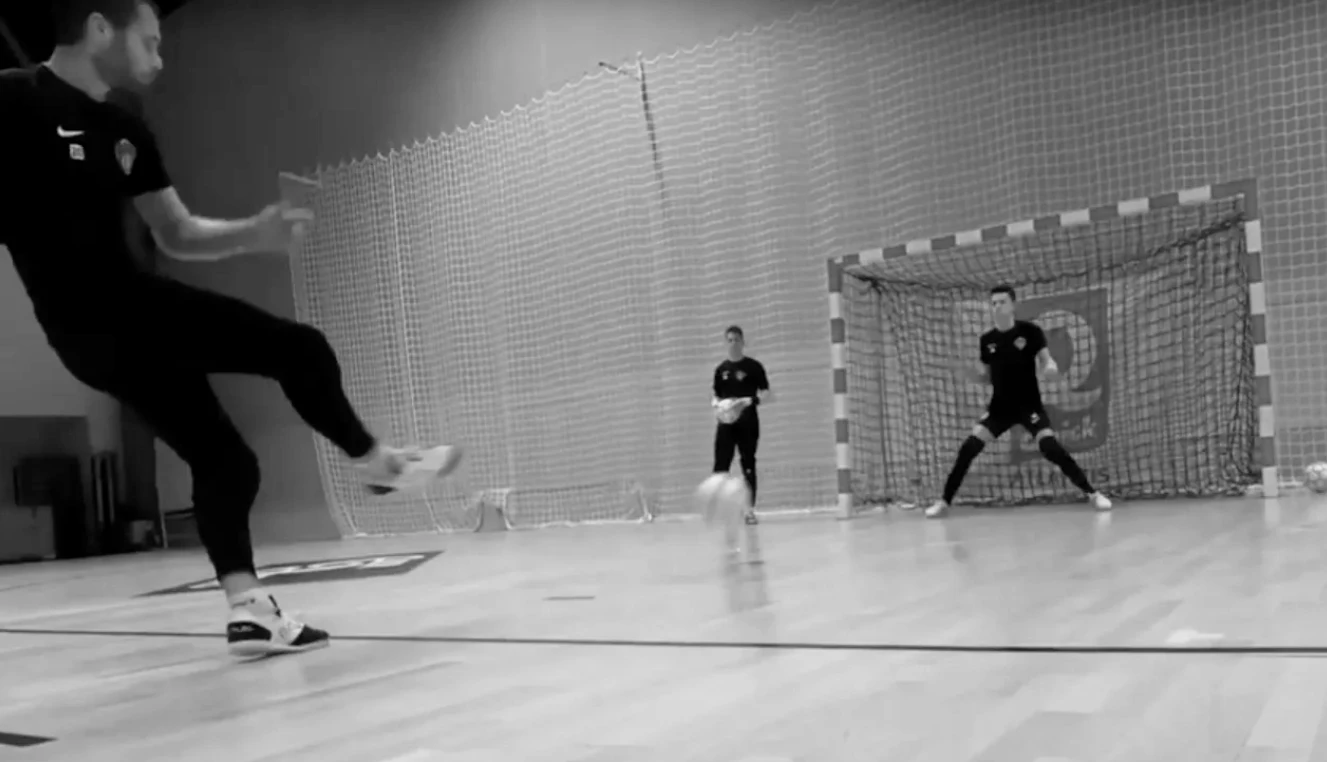
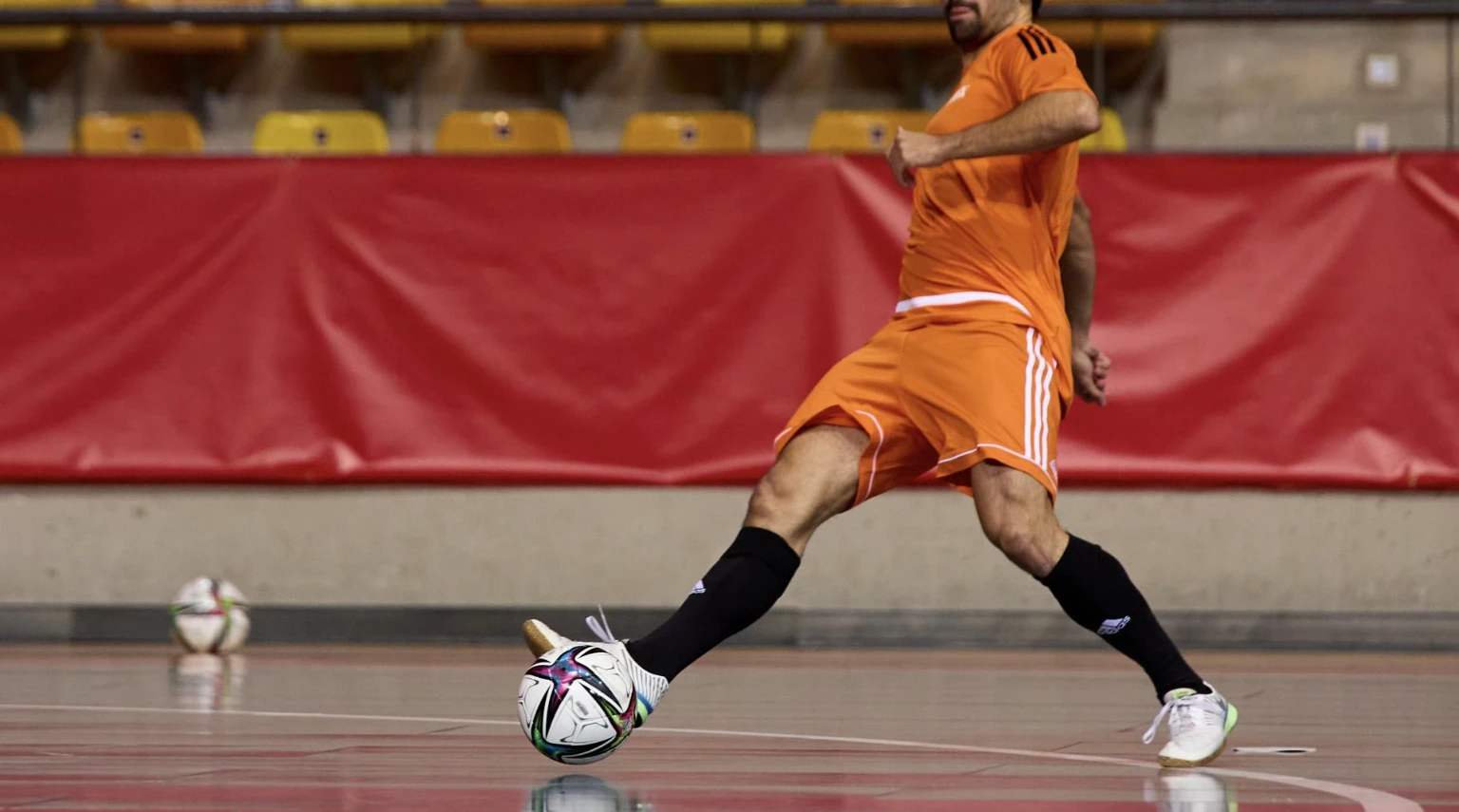
- Striking foot: your foot must be rigid, toes pointing down as if you wanted to “stab” the floor, ankle locked.
- Contact point: strike the ball with the tip of your shoe, just below its centre. Too high and the ball stays on the floor without power; too low and it flies. The aim is the lower part of the centre, for a low, powerful trajectory.
- Movement: the foot movement must be short and sharp, like a hammer blow, not a big swing.
3. Follow-through
After impact, do not stop your foot dead. Continue the movement towards the target. This follow-through helps guide the ball and improves accuracy and power. It is not a big movement as in a football shot, but a natural continuation of the sharp strike.
Tips for a perfect toe poke:
- Lock your ankle: the key to power and to avoiding injury. A loose ankle disperses energy and makes the shot ineffective.
- Strike through the centre: always aim through the centre of the ball for a direct shot.
- Keep it compact: the shorter and quicker the movement, the more surprising the shot.
- Repeat: the toe poke is all about muscle memory. The more you practise, the more natural it becomes.
To improve your shooting and your overall futsal skills, it helps to understand how actions fit into a playing system. Our guide to futsal formations and tactics shows how the toe poke can fit into your team’s attacking strategy.
When to use the toe poke: the ideal situations
The toe poke is not for every situation. It is a specific weapon, deadly in well-defined situations where its advantages become decisive.
1. In tight spaces
Futsal is played on a small court, so players are often under pressure with little space and time.
- In the penalty area: when you are close to goal with a defender tight on you, a laces shot is often impossible. The toe poke, with its minimal back-lift, lets you strike instantly.
- Between several defenders: if you find a small shooting window between defenders’ legs, the toe poke may be the only shot that can get through without being blocked.
2. In quick transitions and counter-attacks
Counter-attacks are key moments in futsal, and speed is everything.
- First time: receive the ball and shoot without controlling it. The toe poke is perfect because it requires no complex body position.
- After a quick dribble: if you have beaten a defender and find yourself in a shooting position, a quick toe poke can surprise the goalkeeper before they readjust.
3. To surprise the goalkeeper
Unpredictability is one of the toe poke’s greatest strengths.
- Mid-range shots: a toe poke can be devastating from 7–10 metres. The ball leaves so fast that the goalkeeper does not see it coming.
- Low shots: the toe poke naturally produces low shots, which goalkeepers struggle with when they arrive at high speed and can deviate.
4. After a feint or change of direction
When you have unbalanced a defender or the goalkeeper with a feint, the toe poke lets you exploit the space immediately. The opponent expects a classic shot with a bigger back-lift, but the toe poke arrives without warning.
5. From direct free kicks
Some futsal players use the toe poke on direct free kicks for its power and its ability to get through the wall or surprise the goalkeeper with an unpredictable flight.
In short, the toe poke is the shot of choice when time and space are limited and surprise is the aim. It is a skill that can turn a simple attacker into a prolific scorer.
Common mistakes to avoid
Powerful as it is, the toe poke is easy to get wrong in ways that reduce its effectiveness or, worse, cause injury.
1. A floppy foot
The most common mistake is not locking the ankle and not keeping the foot rigid. If your foot is loose at impact, the energy of the strike is absorbed and the ball lacks power. You also risk hurting your toes.
2. Hitting the floor before the ball
This often comes from leaning too far forward or a badly placed standing foot. Hitting the floor first not only wastes the chance but can lead to a fall or injury. Make sure your striking foot hits the ball first, and only touches the floor after the follow-through.
3. Too high or too low
- Too high: if the ball flies, you usually struck too far below its centre or leaned too far back.
- Too low (no power): if the ball rolls gently, you struck too far above its centre.
The secret is to aim at the lower part of the centre of the ball for a low, powerful shot.
4. Lack of accuracy
The toe poke is powerful but can be inaccurate if you do not control the direction. This often comes from a badly oriented standing foot or not enough follow-through. Practise aiming at specific targets.
5. Neglecting the follow-through
Stopping your foot after impact reduces the power and fluidity of the shot. The follow-through, even a short one, is essential to transfer all the energy to the ball.
By being aware of these mistakes and correcting them in training, you will greatly improve your toe poke.
Training your toe poke: drills and exercises
Mastery only comes with repetition and targeted practice. Here are some simple exercises you can do alone or with a partner.
1. Shooting against a wall
- Aim: develop power and accuracy.
- How: stand about 3–5 metres from a wall. Strike the ball with a sharp toe poke, aiming at a small target on the wall (a mark, a spot). Collect the ball and repeat.
- Variations:
- Increase the distance.
- Use your weaker foot.
- Strike first time as soon as the ball comes back.
2. Shooting through cones
- Aim: improve accuracy and the ability to aim into tight spaces.
- How: place two cones or small objects to create a “gate” 50 cm to 1 metre wide. Stand 5–7 metres away and try to put the ball through the gate with a toe poke.
- Variations:
- Narrow the gate.
- Add a passive defender to put you under pressure.
3. Shooting after a directional first touch
- Aim: combine ball control with a quick shot.
- How: a partner passes to you. Control the ball into a shooting position, then immediately follow up with a toe poke.
- Variations:
- The partner varies the pace and direction of the passes.
- Add a body feint before shooting.
4. Shooting on the move 🏃
- Aim: learn to toe-poke on the move, as in a match.
- How: dribble for a few metres, then, without slowing down, toe-poke towards the goal or a target.
- Variations:
- Dribble in a zigzag.
- Change direction just before shooting.
Drill summary table
| Drill | Main aim | Equipment | Key tips |
|---|---|---|---|
| Wall shots | Power, repetition | Wall, ball | Focus on a rigid foot |
| Target shots | Accuracy, aiming for corners | Targets (cones), ball | Vary distances and angles |
| Shot after control | Speed of linking actions | Partner, ball, goal | Directional touch to set up the shot |
| Shot on the move | Applying it in game situations | Ball, space, (goal) | Keep balance and fluid movement |
Consistency is key. Spend 10–15 minutes at the end of each session on these exercises and you will see clear improvements.
The toe poke in modern futsal: an essential tactical weapon
Futsal has evolved, and so have its techniques. Once seen as a “last resort”, the toe poke is now an essential tactical weapon, used by the best players and teams in the world.
How the game has changed
With better futsal goalkeepers and more sophisticated defences (such as pressing while outnumbered (FR)), scoring has become harder. Spaces are shrinking and reaction times are shorter. That is where the toe poke really matters.
“In modern futsal, every millisecond counts. The toe poke is the shot that gives you that millisecond’s advantage over the goalkeeper.” – A renowned futsal coach.
Top teams, such as those whose seasons we have analysed, for example Benfica, 2025 Portuguese champions (FR), or Meta Catania, 2025 Italian champions (FR), work on the toe poke in training, and many of the world’s iconic futsal players are known for their lightning toe pokes.
The toe poke’s strategic role
- Breaking compact defences: against a defence sitting deep, a quick toe poke can create an unexpected opening. It forces defenders to react faster and opens space.
- Finishing counter-attacks: the toe poke is the perfect tool to finish a lightning counter-attack before the opponent can get back.
- Attacking variety: a team that masters several types of shot, including the toe poke, is harder to defend against. Goalkeepers cannot anticipate the type of strike.
- Long-range shots: although often used close in, a well-struck toe poke from distance can be just as dangerous, with its floating flight.
Players learn to build it into their attacking movement, using it after a feint, a pass back or even as a pivot. Teams such as Étoile Lavalloise (see their 2025 season review (FR)) show how professional teams exploit every technical advantage.
In the end, the toe poke is much more than a striking technique. It reflects game intelligence and adaptation to futsal’s specific demands. Any player who wants to excel should treat it as a fundamental skill to learn and perfect.
Analysing and improving your shooting: the post-match review
To truly master the toe poke, training is not enough; you also need to analyse your performance. Reviewing your shots after a match or session is crucial to identify strengths and weaknesses.
1. Review the video
If possible, film your matches or training sessions. Watching the footage lets you see objectively:
- Your body position at the moment of the strike.
- The contact point on the ball.
- The ball’s trajectory.
- The situations in which you used the toe poke (successfully or not).
This helps you correct technical errors you do not notice in the moment.
2. Self-assessment and feedback
After each shot, ask yourself:
- Was it powerful?
- Was it accurate?
- Was the trajectory as low as intended?
- Did I lock my ankle?
- Was the timing right?
Ask team-mates or your coach for their opinion too. An outside eye can spot things you missed.
3. Shooting statistics
Keep a shooting log:
- Number of shots taken.
- Number of shots on target.
- Number of goals scored.
- Type of shot (toe poke, laces, etc.).
- Game situation (counter-attack, set attack, etc.).
This data gives you a clear picture of how effective your toe poke is and helps you target your training. A thorough post-match review (FR) gives you tools and methods for this self-analysis.
By combining rigorous training and critical analysis, you will turn your toe poke into a formidable, consistent weapon.
Test your knowledge of the toe poke!
Conclusion: the toe poke, an essential futsal weapon
The toe poke is much more than a hopeful swipe; it is a sophisticated, powerful and unpredictable technique that belongs in every serious futsal player’s arsenal. Its ability to generate explosive power with minimal back-lift makes it a formidable weapon, able to unlock the most complex situations and surprise the most agile goalkeepers.
By mastering body position, precise contact and follow-through, you can turn a basic shot into a real missile. In tight spaces, in quick transitions or to exploit the smallest gap, the toe poke is a major tactical asset.
Never underestimate this shot. Build it into your training, practise it regularly and analyse your performance. You will soon find it can become your signature on the court, helping you score spectacular goals and make the difference at key moments. Futsal is a game of ingenuity and speed, and the toe poke embodies both. For more guides, explore the Training section.